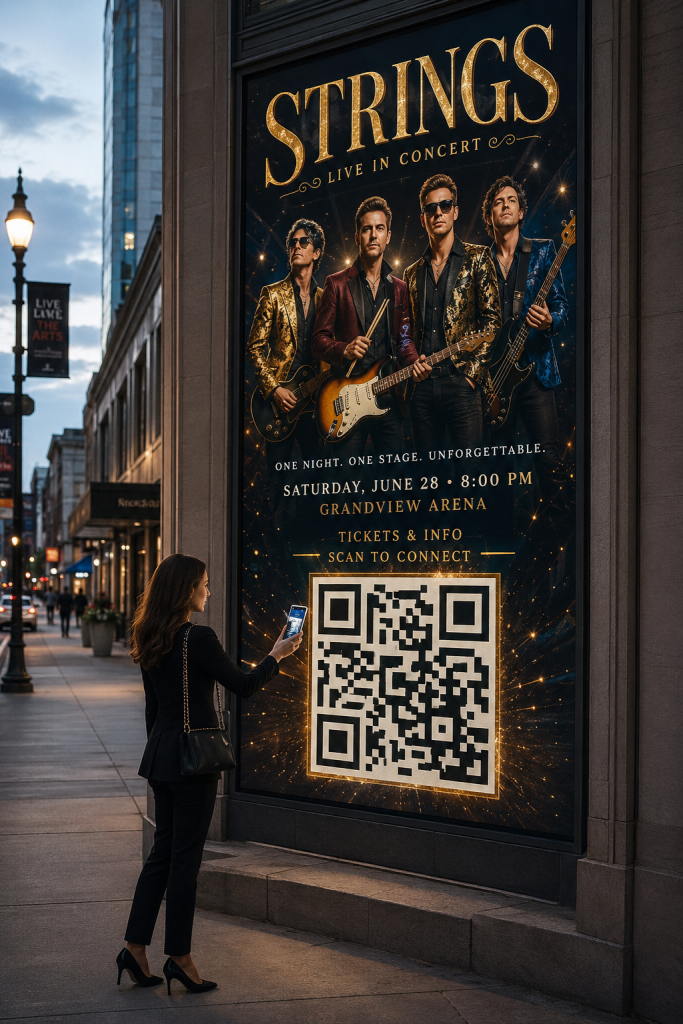
A QR code (short for Quick Response code) is a two‑dimensional barcode made of black and white squares arranged in a square grid. Fundamentally, it’s a compact way to store data that a camera or scanner can read and turn back into digital information. en.wikipedia
What a QR code is, at the elemental level
- Pattern of bits: Each small square (called a module) is either black or white, representing a binary 1 or 0. qrcodekit
- Two-dimensional: Unlike a traditional barcode that only reads left‑to‑right, a QR code encodes data in both horizontal and vertical directions, so it can hold much more information in a small space. en.wikipedia
- Fixed structure: Every QR code has standard parts:
- Position markers (the big squares in three corners) that tell the scanner where the code is and how it’s rotated. qrcodekit
- Data modules that hold the actual encoded information (URL, text, contact info, etc.). qrcodekit
- Error correction built into the pattern so the code can still be read even if part of it is dirty, scratched, or covered. en.wikipedia
What a QR code does
- Stores data: A QR code can encode different types of data, such as:
- Website URLs
- Plain text
- Phone numbers or SMS templates
- Wi‑Fi credentials
- Contact cards (vCard), etc. qrcodekit
- Bridges physical and digital: You print or display the QR code on something physical (poster, product, screen). When someone scans it with a phone camera or QR reader, the device:
- Detects the position markers and orientation.
- Reads the pattern of black/white modules as binary data.
- Uses error correction to reconstruct the original data.
- Interprets the data type and triggers an action (e.g., opens a link, shows text, joins Wi‑Fi). qrcodekit
In essence, a QR code is a small, machine‑readable “data container” that lets you turn a visual pattern into instant digital information with a quick scan. fortinet